
Overview Of The Complement System
- The complement system is a crucial component of innate immunity.
- It consists of multiple proteins circulating as inactive precursors.
- These proteins are primarily synthesised by the liver.
- Once triggered, these proteins activate each other sequentially.
- This sequential activation creates a cascading enzyme reaction.
- The complement system bridges both innate and adaptive immunities.
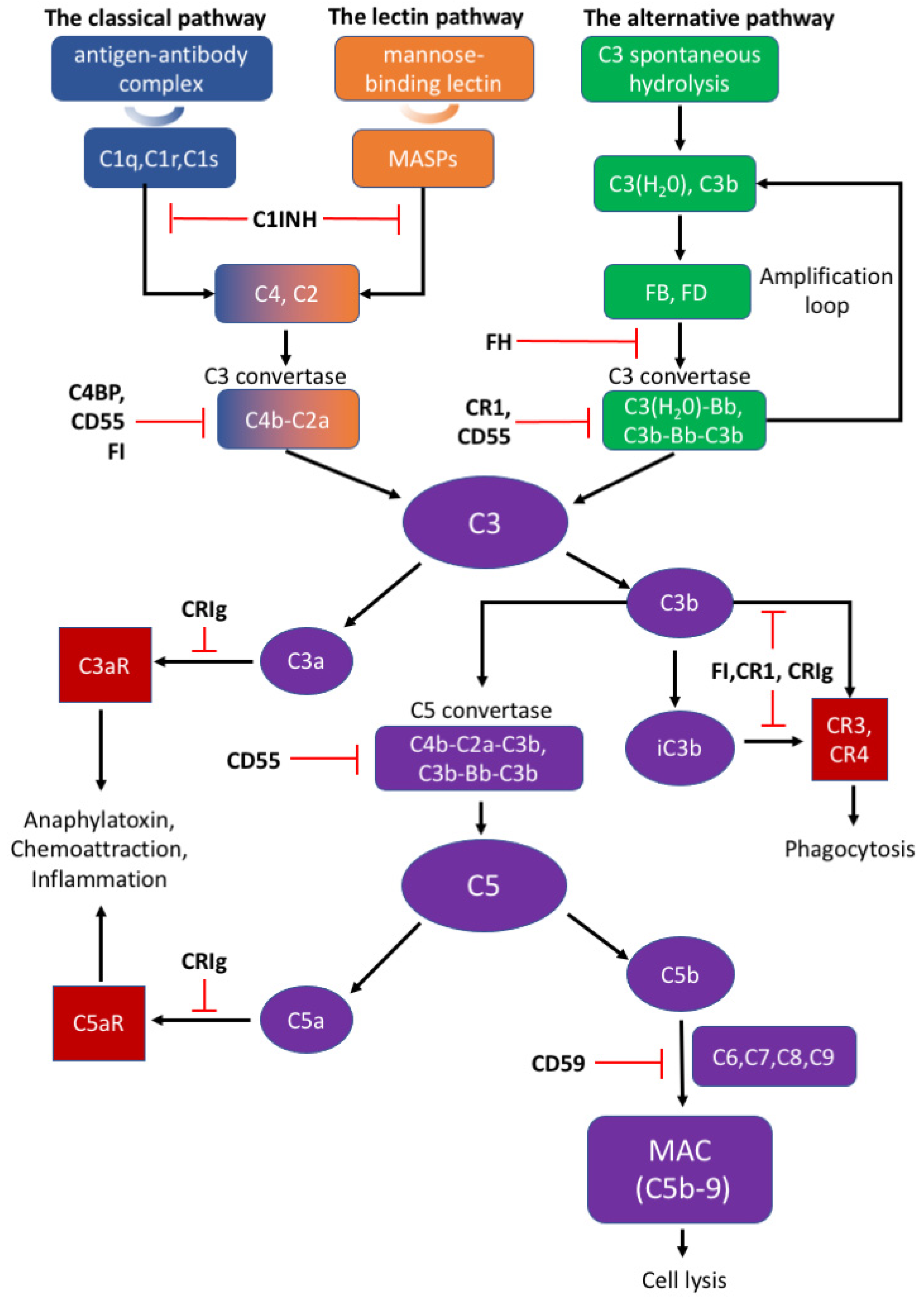
Pathways Of Complement Activation
- The complement cascade is activated via three main pathways.
- The classical pathway is triggered by antigen-antibody immune complexes.
- Immunoglobulins IgM and IgG activate the classical pathway.
- The alternative pathway is continuously active at low levels.
- It is amplified by bacterial lipopolysaccharides, endotoxins, or yeast cell walls.
- The lectin pathway is activated by mannose-binding lectin binding to microbial surface mannose.
- All three pathways converge at the activation of C3.
- This activation leads to the formation of the membrane attack complex (MAC).
Functions Of Complement
- The complement system causes direct lysis of bacteria, viruses, and tumour cells.
- It facilitates opsonisation, enhancing efficient phagocytosis by macrophages and neutrophils.
- It generates chemotactic mediators like C5a to attract polymorphonuclear leukocytes.
- It promotes immune clearance by removing circulating immune complexes to the spleen and liver.
Primary Complement Deficiencies
- Primary complement deficiencies are rare primary immunodeficiency diseases.
- They lead to an increased susceptibility to infections or autoimmunity.
- Different component deficiencies are associated with specific pathogen susceptibilities.
Early Complement Pathway Deficiencies (C1, C4, C2)
- These deficiencies involve the classical complement pathway.
- C2 deficiency is the most common complement pathway deficiency.
- Patients with early component defects lack sufficient opsonisation capabilities.
- They are highly susceptible to encapsulated bacteria.
- Common pathogens include Streptococcus pneumoniae and Haemophilus influenzae.
- C1q, C4, and C2 deficiencies are strongly associated with systemic lupus erythematosus (SLE).
- Nearly 95% of patients with C1q deficiency develop severe autoimmune disease.
C3 Deficiency
- C3 is the central molecule for all complement activation pathways.
- It is a critical opsonin for the ingestion and killing of bacteria.
- C3 deficiency results in severe, recurrent pyogenic sinus and respiratory infections.
- Patients face severe infections from encapsulated bacteria.
- C3 deficiency is also associated with glomerulonephritis.
Late Complement Pathway Deficiencies (C5-C9)
- These terminal components are responsible for assembling the membrane attack complex.
- The membrane attack complex creates pores in cell membranes to cause osmotic lysis.
- Only Gram-negative bacteria are susceptible to this specific bactericidal effect.
- Deficiency of C5, C6, C7, C8, or C9 severely impairs this lytic capability.
- Patients demonstrate a high risk for recurrent Neisseria infections.
- Approximately 40% of these patients develop neisserial meningitis or septicaemia.
Alternative Pathway Deficiencies
- Properdin (Factor P) stabilises the alternative pathway C3 convertase.
- Properdin deficiency is inherited in an X-linked recessive manner.
- This deficiency strongly predisposes the host to severe meningococcal infections.
Regulatory Protein Deficiencies
- C1 esterase inhibitor (C1 INH) prevents unwarranted autolytic complement activation.
- Deficiency of C1 INH causes hereditary angioedema.
- Hereditary angioedema is an autosomal dominant trait.
- It presents with recurrent episodes of localised oedema.
- Oedema affects the face, trunk, extremities, intestines, and larynx.
- Intestinal oedema manifests as severe colicky abdominal pain.
- Laryngeal oedema can cause life-threatening airway obstruction.
- Decay-accelerating factor (DAF) deficiency leads to complement-mediated haemolysis.
- This condition manifests clinically as paroxysmal nocturnal haemoglobinuria.
Diagnostic Evaluation
Initial Screening Assays
- The CH50 assay screens the entire classical complement pathway from C1 through C9.
- A complete deficiency of any classical component results in a zero or near-zero CH50 value.
- Improper sample handling is the most common cause of an abnormally low CH50 result.
- The AH50 assay assesses the alternative complement pathway.
Specific Immunochemical Assays
- Targeted functional testing should only be pursued when CH50 or AH50 values are severely reduced.
- Measurement of individual serum levels of C3 and C4 is widely available.
- Specific components can be quantified using radial immunodiffusion, ELISA, or nephelometry.
- Flow cytometry and haemolytic assays help detect specific terminal pathway defects.
Management And Prognosis
Infection Prevention And Management
- No specific curative therapy exists for primary complement deficiencies.
- Management relies on aggressive treatment of acute bacterial infections.
- Antibiotic prophylaxis against encapsulated organisms is highly beneficial.
- Meningococcal vaccination is the best protective strategy for terminal complement deficiencies.
- Both the quadrivalent (A, C, Y, W-135) and MenB vaccines must be administered.
- Immunisations against Streptococcus pneumoniae and Haemophilus influenzae are also critical.
Management Of Hereditary Angioedema
- Routine acute episodes are treated with targeted therapies.
- Infusion of synthetic C1 esterase inhibitor is required for acute laryngeal attacks.
- Prophylactic therapy includes attenuated androgens like danazol or stanozolol.
- Tranexamic acid can also provide significant clinical improvement.
Autoimmunity Surveillance
- Close clinical surveillance for systemic lupus erythematosus is required.
- This is particularly important for patients with C1, C2, C4, and C5 deficiencies.
Summary Of Complement Deficiencies
| Deficiency | Pathway/Mechanism | Clinical Infections & Features | CH50 Level |
|---|---|---|---|
| C1, C4, C2 | Classical pathway defect; reduced opsonins | Pyogenic infections (encapsulated bacteria); high risk for SLE | <10% (Severely Low) |
| C3 | Central component defect; poor opsonisation | Severe recurrent pyogenic sinus and respiratory infections | Severely Low |
| Properdin | Alternative pathway; unstable C3 convertase | Pyogenic and Neisseria infections (X-linked recessive) | Normal (AH50 is Low) |
| C5-C9 | Terminal pathway defect; impaired MAC formation | Recurrent Neisseria meningitidis infections | >50% (Normal to slightly low) |
| C1 INH | Lack of classical pathway regulation | Hereditary angioedema (bradykinin-mediated mucosal swelling) | Variable |