
Algorithm
graph TD


A(<b>Pediatric Burn</b>):::start
B1[<b>Prehospital Care</b><br>Extinguish and wrap]:::step
B2[<b>Primary Survey</b><br>ABCDE assessment]:::step
B3[<b>Special Injuries</b><br>Identify mechanism]:::step

A --> B1
A --> B2
A --> B3

C1[<b>Minor Burns</b><br>Cool water under 10 TBSA]:::step
C2[<b>Major Burns</b><br>No cold water over 15 TBSA]:::alert

B1 --> C1
B1 --> C2

D1[<b>Airway Management</b><br>100 Oxygen and intubate]:::step
D2[<b>Circulation Access</b><br>IV or IO placement]:::step
D3[<b>Calculate Severity</b><br>Lund-Browder TBSA]:::step

B2 --> D1
B2 --> D2
B2 --> D3

E1{<b>Burn Center Required</b>}:::decision

D3 --> E1

F1[<b>Burn Center Transfer</b><br>Critical or large burns]:::alert
F2[<b>Standard Care</b><br>Local wound management]:::step

E1 -->|Yes| F1
E1 -->|No| F2

G1[<b>Resuscitation</b><br>4mL x kg x TBSA volume]:::step
G2[<b>Nutritional Support</b><br>Early enteral feeding]:::step

F1 --> G1
F1 --> G2

H1[<b>Topical Agents</b><br>No systemic antibiotics]:::step
H2[<b>Surgical Care</b><br>Escharotomy or grafting]:::step

F2 --> H1
F1 --> H2

I1[<b>Inhalation Injury</b><br>Hydroxycobalamin for cyanide]:::alert
I2[<b>Electrical Injury</b><br>ECG and forced diuresis]:::alert

B3 --> I1
B3 --> I2
Epidemiology And General Principles
- Unintentional fire-related injuries account for approximately 10% of unintentional injury-related pediatric deaths.
- Children face higher mortality risk compared to adults.
- Scald burns represent leading hospitalization cause in children under 4 years, comprising 65% of admissions.
- Flame burns manifest most frequently in children over 5 years.
- Child abuse contributes to approximately 18% of burn injuries.
- Abuse presents typically as glove or stocking distribution, isolated deep trunk burns, or circular cigarette burns.
- Loss of skin integrity precipitates hypothermia, massive fluid loss, and environmental microbial invasion.
Prehospital And Emergency First Aid
- Wrap victim in blanket immediately at scene.
- Extinguish flames by rolling victim on ground.
- Avoid running with burning clothes.
- Extricate safely to airy environment.
- Prevent continued inhalation of carbon monoxide and cyanide.
- Remove smoldering clothing immediately.
- Remove constricting jewelry to prevent vascular compromise during edema phase.
- Irrigate minor burns under 10% TBSA with cool tap water for 10-20 minutes.
- Cold water application strictly contraindicated for burns exceeding 15% TBSA due to severe hypothermia risk.
- Avoid home remedies including grease, soda, butter, oil, powder, or toothpaste.
- Cover wound strictly with clean dry sheeting or sterile dressing.
Primary Survey And Acute Resuscitation
Airway And Breathing Management
- Administer 100% oxygen immediately for facial burns, singed hair, carbonaceous sputum, or suspected smoke inhalation.
- Assess airway strictly for laryngeal edema, stridor, or retractions.
- Perform early elective intubation for any evidence of significant airway compromise.
Circulation And Hemodynamics
- Obtain intravenous access in non-burned areas preferably.
- Utilize burned areas for vascular access if alternative sites remain unavailable.
- Place intraosseous line if intravenous access fails emergently.
- Replace intraosseous access with central venous line subsequently.
Disability And Exposure Control
- Perform rapid neurological assessment evaluating hypoxia or carbon monoxide poisoning.
- Expose fully to calculate TBSA accurately.
- Assess concurrent injuries thoroughly.
- Cover immediately with warmed blankets preventing hypothermia.
- Maintain cervical spine precautions for explosion, fall, or high-voltage mechanisms.
Assessment Of Burn Severity
Classification Of Burn Depth
- Accurate classification guides treatment and predicts scarring.
| Burn Depth Classification | Anatomical Involvement | Clinical Characteristics | Prognosis And Healing |
|---|---|---|---|
| First-Degree | Confined strictly to epidermis | Erythematous, dry, painful, lacks blistering. | Heals within one week without scarring. |
| Second-Degree | Epidermis and variable dermis portion | Moist blebs and blisters; mottled pink/white underlying tissue; exquisitely painful. | Superficial heals in 7-14 days; deep requires over 3 weeks, leaving scar. |
| Third-Degree | Complete destruction of epidermis and dermis | Leathery, dry, mottled, non-blanching; insensate center due to destroyed nerve endings. | Cannot regenerate; requires surgical excision and skin grafting. |
|  |
Estimation Of Total Body Surface Area
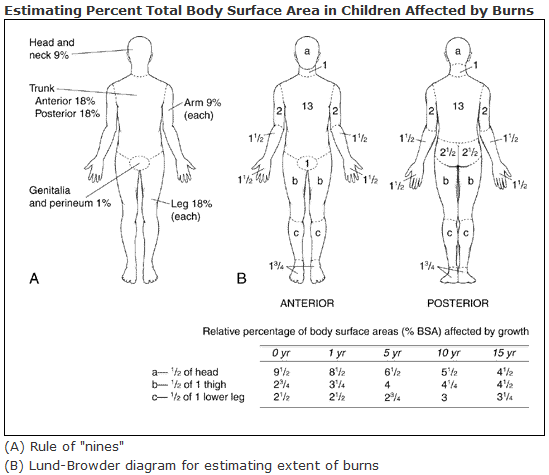
- Rule of nines remains inaccurate for children under 15 years.
- Larger head-to-body mass ratio dictates specialized assessment.
- Variable extremity growth requires age-specific evaluation tools.
- Utilize Lund and Browder chart for accurate pediatric estimation.
- Utilize child's palmar surface including fingers for rapid 1% TBSA estimation.
Indications For Burn Center Admission
- Appropriate triage minimizes pediatric morbidity and mortality.
| Clinical Criteria For Burn Center Referral |
|---|
| Partial-thickness burns involving greater than 10% TBSA. |
| Full-thickness burns involving greater than 5% TBSA at any age. |
| Burns involving critical areas: face, hands, feet, genitalia, perineum, or major joints. |
| Electrical burns including high-tension wire and lightning injuries. |
| Chemical burns and suspected inhalational injury. |
| Burn injuries complicated by pre-existing medical conditions. |
| Concomitant trauma or suspected child abuse/neglect. |
Fluid Resuscitation And Hemodynamic Monitoring
- Replenish massive fluid losses aggressively.
- Maintain adequate end-organ perfusion.
- Protect ischemic zone without overloading pediatric circulation.
- Initiate rigorous intravenous resuscitation for burns exceeding 10-15% TBSA.
- Institute strict urinary catheterization for continuous output monitoring.
Resuscitation Formulas And Administration
| Component | Calculation And Administration Guidelines |
|---|---|
| Resuscitation Volume | Volume equals 4 mL multiplied by weight multiplied by percent TBSA burn. Ringer's lactate serves as preferred isotonic crystalloid. |
| Administration Schedule | Infuse half calculated volume during first 8 hours post-injury. Infuse remaining half over subsequent 16 hours. |
| Maintenance Fluids | Required for children under 20 kg. Provide 5% dextrose in normal saline or Ringer's lactate. |
| Monitoring Targets | Maintain urine output above 1 mL/kg/hr for infants. Target 0.5 mL/kg/hr for children over 20 kg. |
Hemodynamic Adjustment Protocols
- Increase fluid infusion rate by 10% if urine output falls below target.
- Decrease infusion rate by 10% if urine output exceeds target.
- Recognize tachycardia as unreliable resuscitation marker due to profound hypermetabolism.
- Insert central venous lines for reliable volume delivery in burns over 20% TBSA.
- Adjust second 24-hour fluids accounting for insensible losses and wound exudation as capillary leak seals.
Analgesia, Sedation, And Nutrition
Pain And Anxiety Management
- Implement multimodal pain approach addressing wide intensity fluctuations.
- Administer scheduled long-acting opioids for background pain.
- Utilize potent short-acting intravenous opioids for procedural pain.
- Administer midazolam for procedural anxiolysis.
- Schedule gabapentin targeting neuropathic pain.
Metabolic And Nutritional Support
- Anticipate severe hypermetabolic and catabolic state.
- Target massive protein intake reaching 2-4 g/kg/day for survival.
- Initiate enteral feeding via nasogastric or nasojejunal tube on admission day.
- Preserve gastrointestinal mucosal integrity through early enteral feeding.
- Calculate infant caloric requirements: 2100 Cal/m2 plus 1000 Cal/m2 burn surface area.
- Calculate child caloric requirements: 1800 Cal/m2 plus 1300 Cal/m2 burn surface area.
Wound Care And Topical Antimicrobial Therapy
General Wound Management
- Avoid prophylactic systemic antibiotics strictly.
- Systemic antibiotics promote resistant pathogens without preventing sepsis.
- Rely entirely on local topical antimicrobial agents.
- Leave minor burn blisters intact.
- Debride ruptured blisters removing devitalized tissue.
Specific Topical Agents
| Antimicrobial Agent | Clinical Characteristics And Adverse Effects |
|---|---|
| 0.5% Silver Sulfadiazine | Painless application with soothing effect. Limits fluid loss. Adverse effects include transient leukopenia, skin rash, thrombocytopenia. |
| Mafenide Acetate | Exhibits excellent penetration through thick eschar. Agent of choice for deep burns and cartilaginous surfaces. Induces severe application pain and metabolic acidosis. |
| 0.5% Silver Nitrate | Provides broad-spectrum coverage for sulfa-allergic patients. Causes gray wound staining. Induces severe electrolyte derangements including hyponatremia and hypokalemia. |
Surgical Intervention
- Perform prompt decompressive escharotomy for circumferential extremity or truncal burns.
- Prevent compartment syndrome and respiratory restriction aggressively.
- Execute early surgical excision of eschar for deep burns exceeding 10% TBSA.
- Perform autologous skin grafting rapidly to prevent systemic sepsis and optimize functional outcomes.
Management Of Special Burn Injuries
Inhalational Injuries
- Suspect inhalation injury in closed-space fires.
- Identify singed facial hair, carbonaceous sputum, hoarseness, or altered sensorium.
- Confirm carbon monoxide poisoning via elevated carboxyhemoglobin levels.
- Administer 100% oxygen immediately.
- Oxygen dramatically reduces carbon monoxide elimination half-life from 4 hours to 40 minutes.
- Suspect cyanide toxicity with synthetic material combustion.
- Administer intravenous hydroxycobalamin 70 mg/kg addressing cyanide toxicity.
- Hydroxycobalamin binds cyanide forming stable cyanocobalamin for urinary excretion.
- Avoid amyl nitrite and sodium nitrite strictly due to severe methemoglobinemia induction risk.
Electrical Injuries
- Anticipate direct contact or arcing mechanisms.
- Characterized distinctly by specific entry and exit wounds.
- Recognize surface burns severely underestimate deep tissue destruction.
- Disconnect patient immediately from power source utilizing non-conductive materials.
- Initiate continuous cardiac monitoring due to fatal arrhythmia risk.
- Anticipate massive muscle necrosis precipitating myoglobinuria.
- Mitigate acute renal failure risk via aggressive fluid resuscitation and forced alkaline diuresis.
- Monitor closely for deep compartment syndrome.
- Perform urgent fasciotomies and aggressive surgical debridement for necrotic muscle.